

Dry your own lumber in a solar-powered shipping-container kiln
Turn one 40 ft high-cube container into a 5,000 board-foot lumber kiln or a 7-cord firewood kiln. The new plans add bifacial solar panels, variable-speed fans that run on ordinary single-phase power, and a solar paint scheme. They are written for sawmill owners, not kiln engineers.
38-page printable book · 12 drawing sheets · step-by-step checklist · parts lists

The proven container kiln, updated for today's sawmill
The core kiln is unchanged: an insulated container, a hot-water heat coil system, fans, vents and dry-bulb / wet-bulb controllers. The Rev 2026 plans change how it is powered.
Bifacial solar PV
Ten 580 W bifacial panels on a 40° roof rack, plus ten mounted vertically on the south wall with an air gap so reflected light reaches their backs. The racks clamp to the container frame, with no holes in the insulated walls.
Single-phase VFD fan drives
Six 1 HP 3-phase fans, each run by its own AutomationDirect GS21X-21P0 drive from standard 240 V single-phase power. The drives give soft start, motor protection and speed control.
Fan speed schedule
Fans run at 60 Hz for green wood, then step down to 50 and 40 Hz as the wood dries. That cuts fan electricity by about a third over a charge.
Solar paint scheme
The roof and panel wall are painted high-reflective white to boost the bifacial panels. The north wall, ends and doors are painted flat black to absorb sun.
Fan / heat safety interlock
The heat only runs while all six fans run. One emergency stop shuts every fan off.
Shaded equipment board
The inverter, drives and controllers sit on a roofed board outside the kiln, away from heat and steam. Wire, breaker and grounding schedules are included.
Two arrays, one container, no extra land
The roof and the south wall of a 40 ft container already face the sun. The plans use both.
- Roof array: 10 panels in portrait at 40°, facing south, on 7 galvanized strut A-frames. Includes a full cut list.
- Side array: 10 panels standing vertically on the south wall, 10 in out from a white wall. They produce best in winter, when the sun is low, and shed snow.
- Strings and wiring: four 5-panel strings, roof and wall on separate inverter inputs, with rapid shutdown and grounding details.
- Wind safety: details for anchoring all four corners so the roof array can't lift an empty kiln.
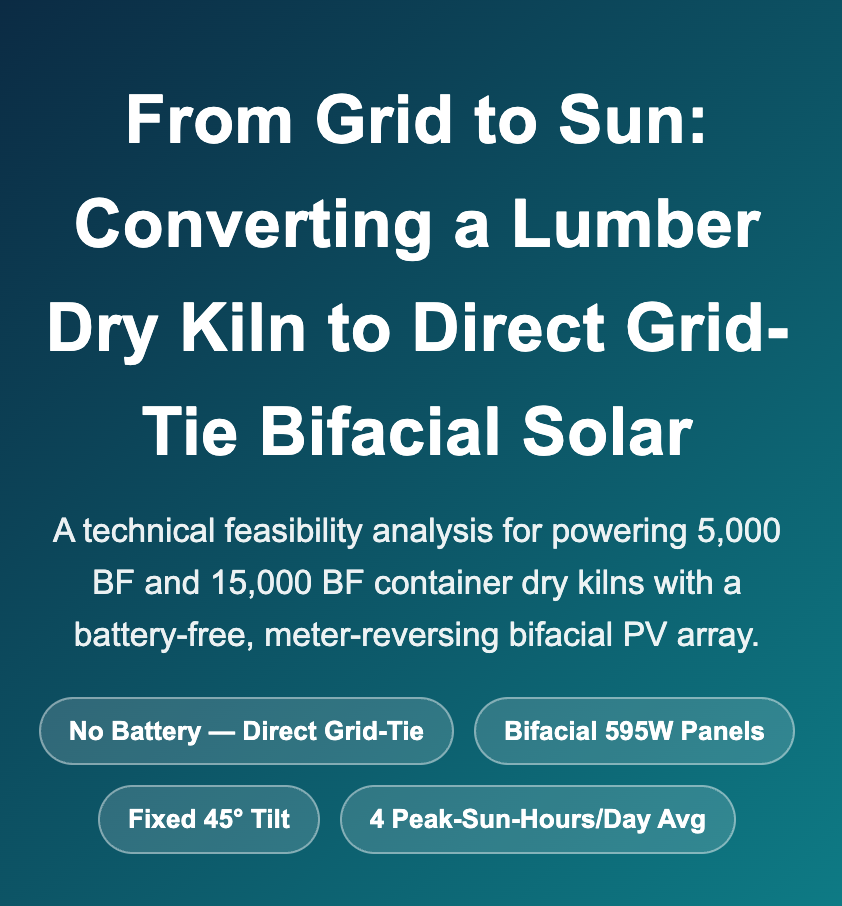

Estimate for a site near 43° N (e.g. Madison, Wisconsin). Your results depend on location, weather and how many days a year the kiln runs.
Let the sun run the fans
Fans, pump, vents and controls use about 85 kWh per day while drying. The 20-panel system makes about 13,500 kWh a year, roughly half of the kiln's yearly electric use when net-metered.
The VFD speed schedule saves about another third of the fan energy. At $0.15/kWh, the solar and the speed schedule together are worth about $4,000 a year.
Heat still comes from your boiler (wood, gas or propane). The plans say so plainly: solar runs the electrical side of the kiln.
3-phase fans on a single-phase farm service
Most sawmill sites only have single-phase power. Each fan in these plans gets its own small variable-frequency drive. The drive takes 240 V single-phase in and puts 3-phase out to a 1 HP inverter-duty motor.
- One drive per fan: if one fails, the other five keep the air moving.
- The drives replace motor starters, with built-in overload protection and soft start.
- Speed is set on the drive keypad, with a recommended Hz setting for each drying stage.
- Full wiring detail, from the panel breaker to the motor terminal box.
- Have 3-phase power? A 3-phase option is included.

Drawings a non-expert can build from
The book is in 8.5 × 11 in format, made to print at home. Text pages read like a normal book; drawing sheets are landscape, with full dimensions and numbered callouts. Each section points to the drawing that shows it.


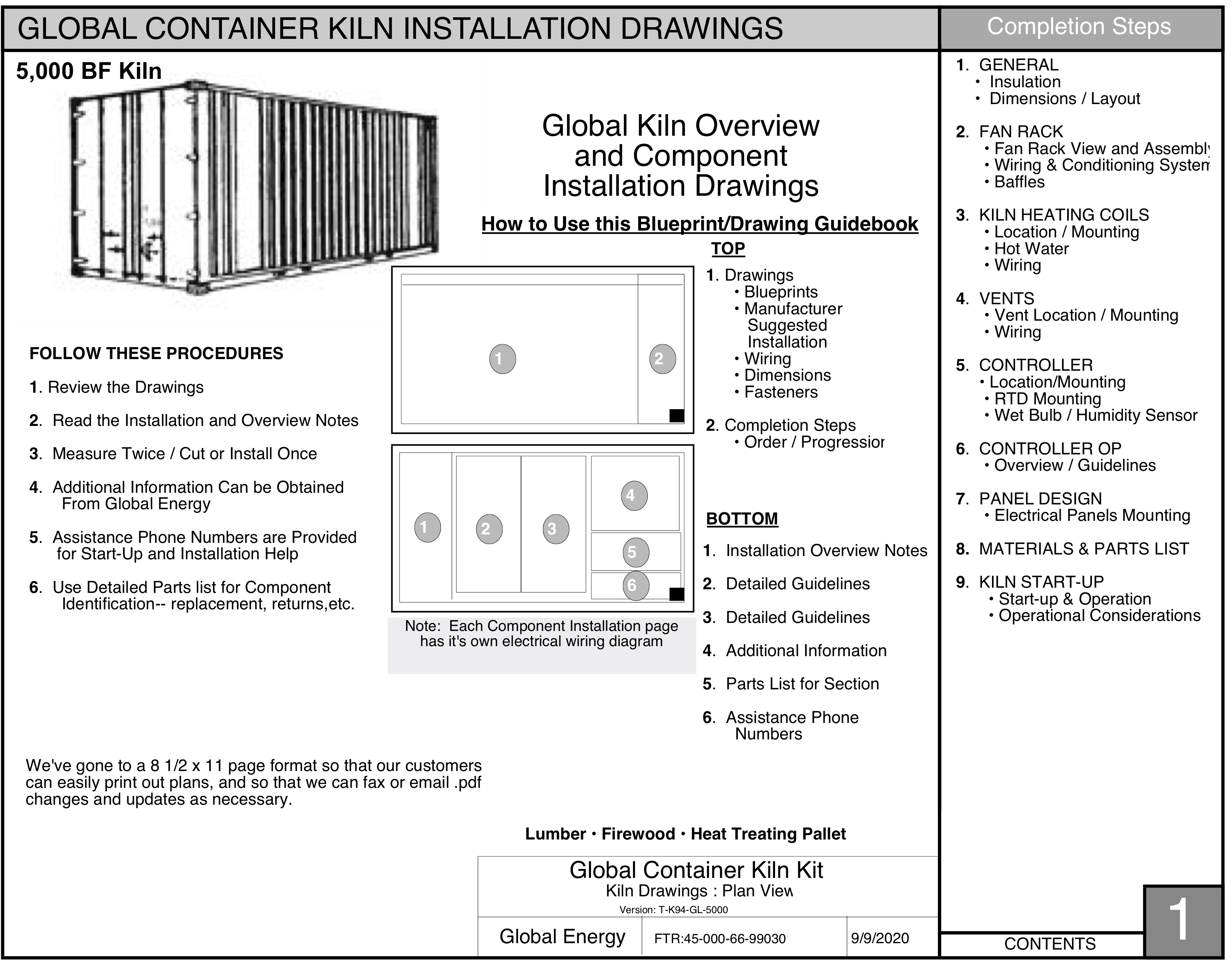
What you get
Container prep and insulation · fan rack and motors · hot-water heating coils · vents · controllers and drying operation · electrical one-line and VFD wiring · solar racks and wiring · paint · energy budget
Build tools
A tick-box build checklist, materials and parts lists with a rough budget, VFD setup values, a breaker and wire schedule, and a "who does what" table showing which jobs need a licensed electrician.
Run it
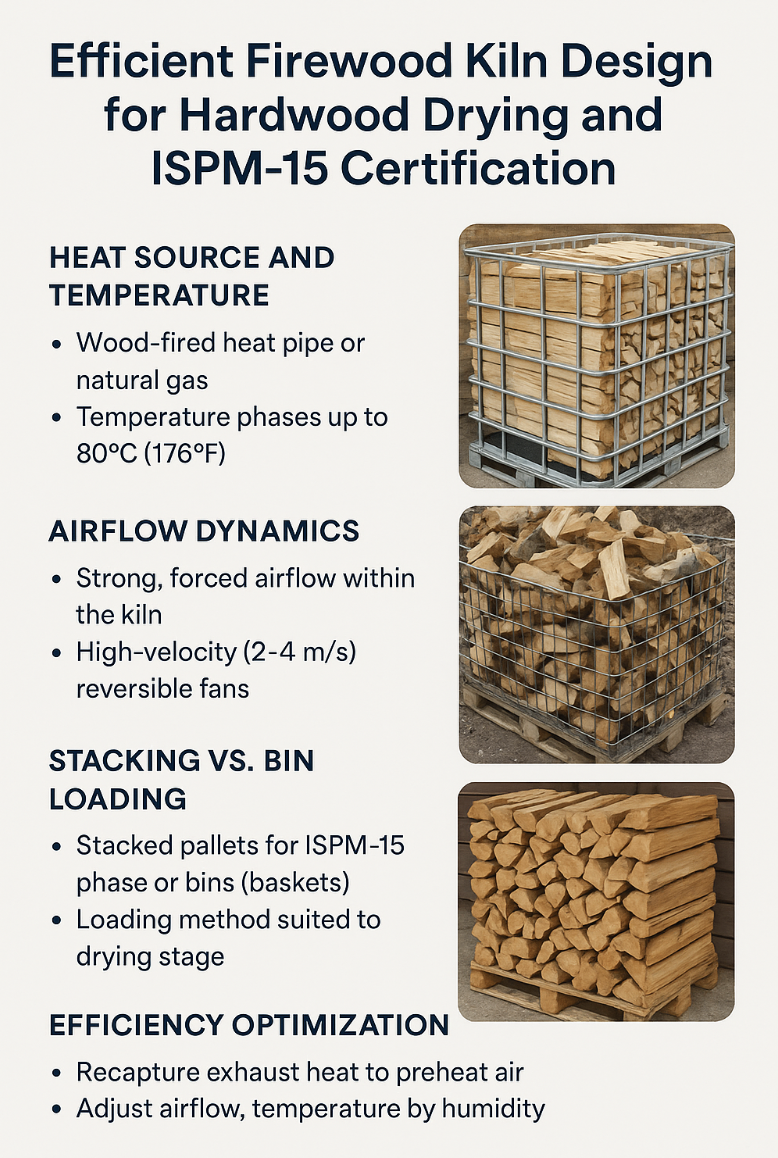
Start-up steps, set-points for lumber and firewood, fan speed schedule, maintenance calendar, a printable daily kiln log, and the USDA firewood kiln-drying research note.
At a glance
| Chamber | One 40 ft high-cube shipping container (40' × 8' × 9'6"), insulated to R-14 with a plywood liner. A 15,000 BF version uses two containers side by side. |
|---|---|
| Capacity | 5,000 BF lumber or 7 cords of firewood per charge |
| Fans | 6 × 24 in fans, 1 HP 3-phase inverter-duty motors, ≈ 6,860 CFM each (free air) |
| Fan drives | 6 × AutomationDirect DURApulse GS21X-21P0 (230 V single-phase in, 3-phase out, NEMA 4X) |
| Heat | Hot-water coils fed by an outside boiler (wood, natural gas or propane); ≈ 125,000 BTU/hr for 5,000 BF |
| Controls | Dry-bulb (heat) and wet-bulb (vents) controllers, two motorized vents, fan / heat interlock |
| Solar PV | 20 × 580 W bifacial panels = 11.6 kW: 10 on a 40° roof rack + 10 vertical on the south wall |
| Electrical service | 120/240 V single-phase, 100 A (3-phase option included) |
| Exterior | High-reflective white roof and panel wall; flat black north wall, ends and doors |
| Plans format | 38 printable pages, letter size: portrait text pages and landscape drawing sheets |
Sawmill owners who want dry wood on their own schedule
- Portable and small sawmill owners who want to sell kiln-dried lumber.
- Firewood producers drying and heat-treating firewood for market.
- Woodworkers and slab dealers tired of waiting a year for air drying.
- Farms with a south-facing yard, single-phase power and a boiler or wood heat.
Some steps, such as the utility hookup, solar connection and boiler piping, must be done by a licensed electrician or plumber. The plans mark exactly which ones.
Plans, parts or a full build
Rev 2026 Plans
- 38-page printable plan book (PDF)
- 12 drawing sheets with dimensions
- Solar PV, VFD and paint upgrades
- Parts lists, checklist and kiln log
Parts & fan packages
- Fans, motors and drives
- Heating coils, vents and controllers
- Help selecting solar panels and an inverter
Full build / consulting
- Turn-key kiln builds
- Site, heat source and solar sizing
- Firewood heat-treatment setups
Questions sawmill owners ask
Do I need 3-phase power?
No. Each 1 HP 3-phase fan motor runs from its own VFD fed by ordinary 240 V single-phase power. If you already have 3-phase power, the plans include that option too.
Will solar heat the kiln?
No. Solar panels make electricity for the fans, pump, vents and controls, about half of the kiln's yearly electric use. Drying heat comes from your boiler. The black walls help a little on sunny days, and the plans give realistic numbers.
Can I run the kiln off-grid?
Not practically. The kiln uses about 85 kWh per day while drying. The plans are designed for grid-tied solar with net metering. A hybrid inverter with a battery can keep the fans running through short outages.
Why bifacial panels and white paint?
Bifacial panels collect light on both faces. The white roof under the tilted array and the white wall behind the vertical array reflect extra light onto the panel backs, and the white also keeps the panels cooler.
Which way should the container face?
Long axis east–west, so the roof array tilts south and the vertical array hangs on the south wall. The plans show what to change if your site forces a north–south layout.
Do I need any professionals?
A licensed electrician should do the utility service and solar connection, and a plumber the boiler piping. Most other work, including insulation, the fan rack, racks, panels, paint and the equipment board, is DIY with a helper.
Stop waiting on the weather to dry your wood
Build a container kiln that pays part of its own power bill.
Questions? Email greg@globalmicroturbine.com