Dry and heat-treat firewood with free sawdust heat. A Conifer sawdust burner fires a 16 in stainless heat pipe inside a shipping-container chamber. Clean indirect heat, no boiler, no steam.
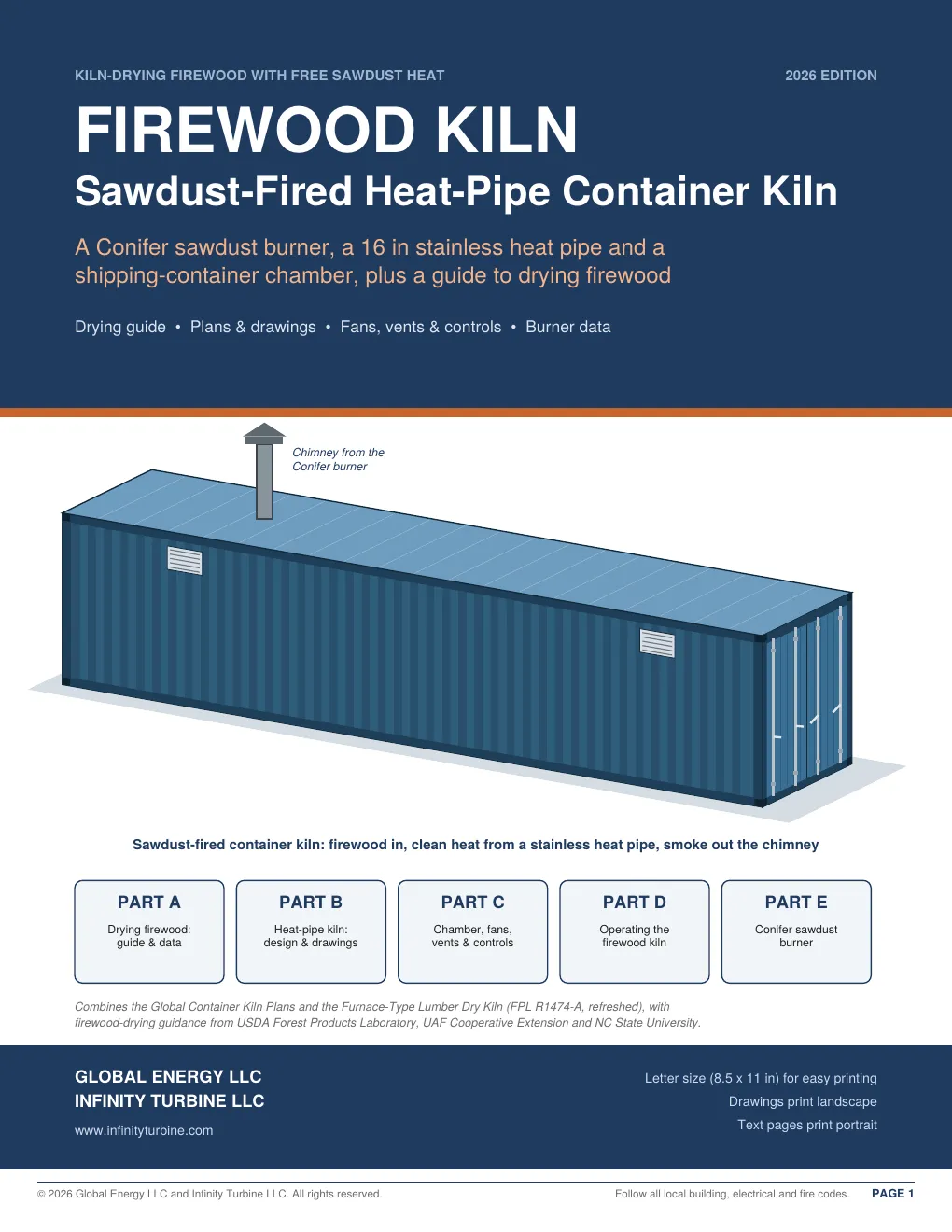
This publication joins two Global Energy / Infinity Turbine works. The chamber, fans, vents and controls come from the Global Container Kiln Plans. The heat comes from the Furnace-Type Kiln: a Conifer sawdust burner firing a stainless heat pipe, after the USDA Forest Products Laboratory experimental kiln of 1945.
Part A is a firewood-drying guide drawn from USDA FPL research, University of Alaska Fairbanks Cooperative Extension and NC State University, summarized in plain language and credited on each page.
Drying firewood: moisture, seasoning, methods, drying time, heat treatment, water and heat per charge.
Heat-pipe kiln design and drawings: twin and single container, pipe details, sizing.
Chamber, fans, VFD wiring with burner interlock, vents, controls and materials.
Running a firewood charge, safety checklist, maintenance, and the Conifer burner literature.
The burner and the drying chamber are separated. Only the stainless pipe crosses the partition, so the firewood sees clean hot air and never the flue gas.
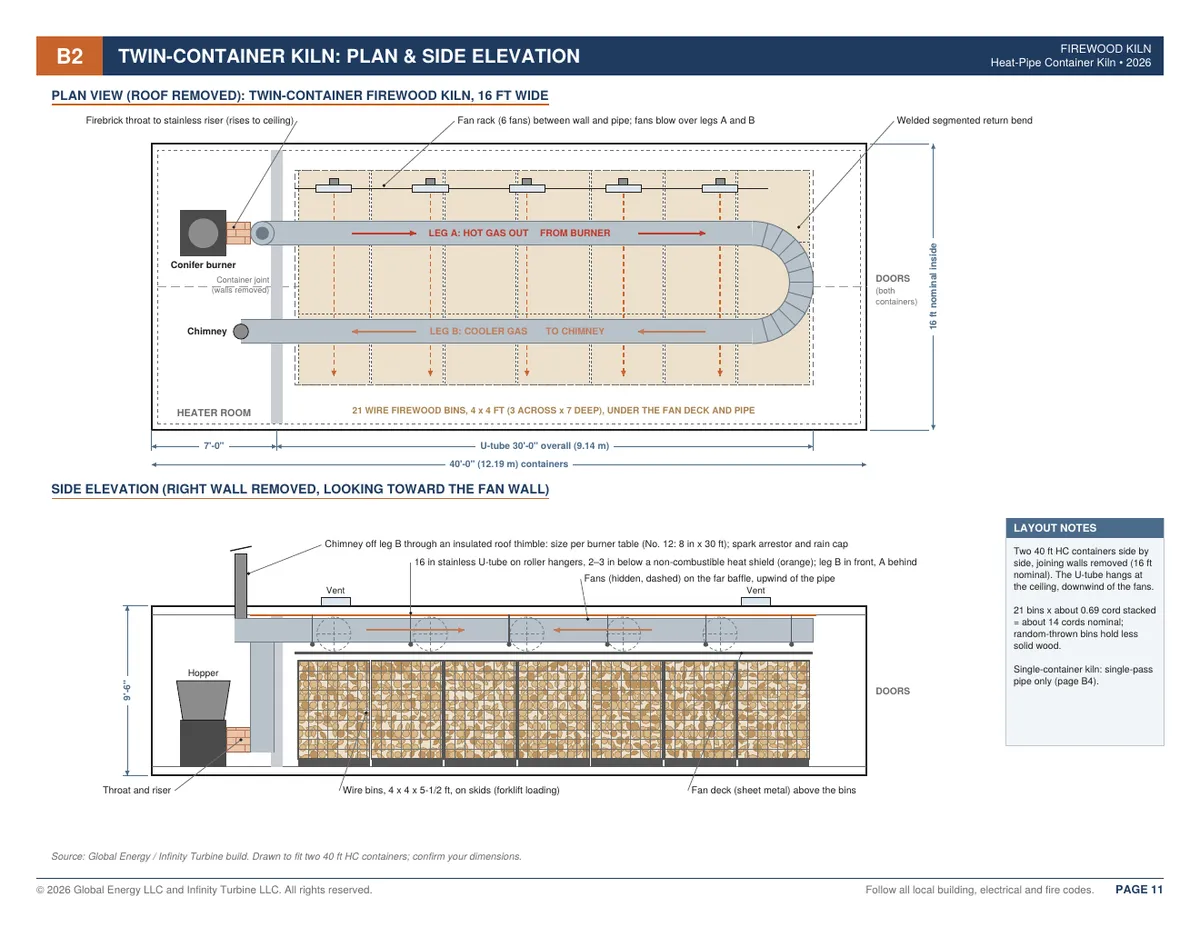
A Conifer burner in a heater room at the blind end feeds green sawdust by gravity from its hopper.
Hot gas runs through a 16 in stainless heat pipe hung just below the ceiling, then out the chimney.
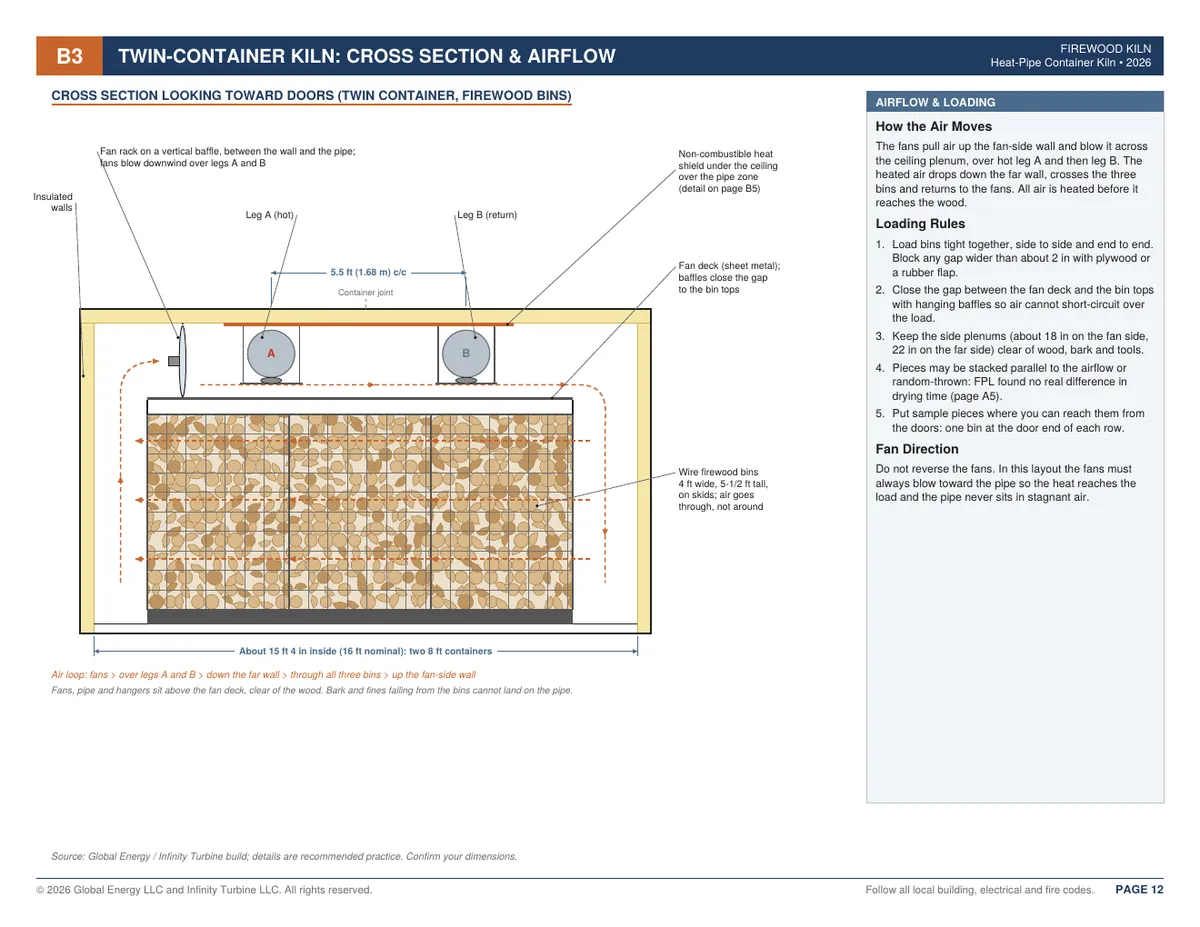
Fans between the wall and the pipe blow downwind over it. The heated air drops down the far wall.
Air passes through bins of split firewood and returns to the fans. Vents release the moisture.
Twin containers for production, or a single container for a smaller yard.
| Item | Twin-container kiln | Single-container kiln |
|---|---|---|
| Chamber | 2 × 40 ft hi-cube joined, about 15 ft 4 in inside | 1 × 40 ft hi-cube, about 6 ft 10 in inside |
| Burner | Conifer No. 12 (No. 14 for very cold sites) | Conifer No. 10 or 11 |
| Heat pipe | 16 in OD stainless U-tube, 30 ft; about 259 sq ft heated surface | 16 in OD stainless single pass, about 30 ft; about 126 sq ft |
| Heat to kiln | About 184,000–307,000 Btu/h | About 120,000–200,000 Btu/h |
| Load | 21 bins, 4 × 4 × 5-1/2 ft, about 14 cords | 8 bins, about 5–6 cords |
| Dry bulb | 180 °F maximum | Same |
| Drying time | About 4–6 days, green oak to 20% | Same |
| Fuel per charge | About 4–5 tons of sawdust | About 2–2.5 tons |
Heat outputs, fuel use and drying times are engineering estimates for planning. Measure your own kiln.
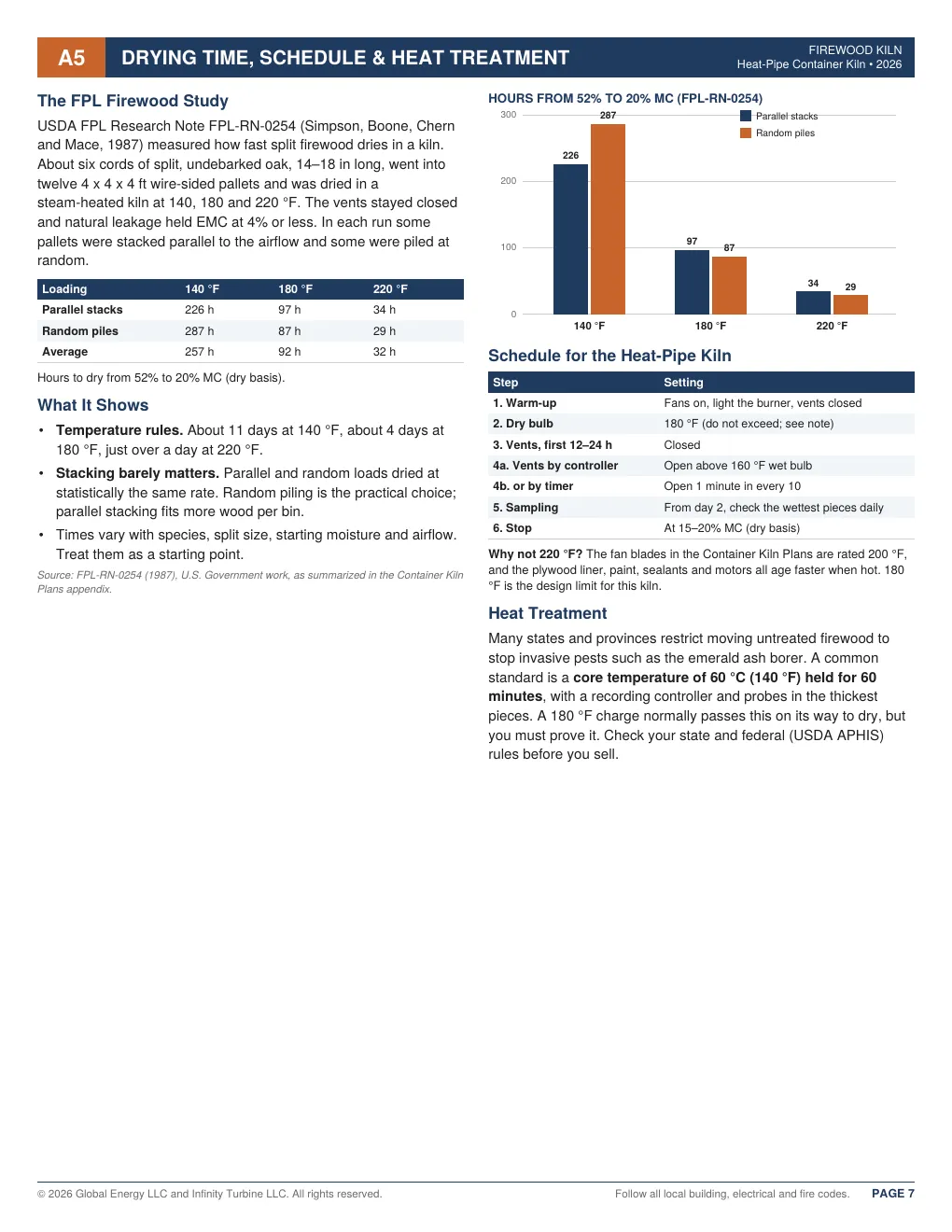
USDA FPL Research Note FPL-RN-0254 measured split oak dried from 52% to 20% moisture content in a heated kiln:
| Loading | 140 °F | 180 °F | 220 °F |
|---|---|---|---|
| Parallel stacks | 226 h | 97 h | 34 h |
| Random piles | 287 h | 87 h | 29 h |
| Average | 257 h | 92 h | 32 h |
That is about 11 days at 140 °F, about 4 days at 180 °F and just over a day at 220 °F. Random piling dried about as fast as stacking, so thrown bins work.
A common heat-treatment standard is a core temperature of 60 °C (140 °F) held for 60 minutes, proven with a recording controller. A 180 °F charge normally passes on its way to dry. Check your state and federal rules before you sell.
Worked example for the twin-container kiln: 14 cords of oak, 52% to 20% MC, at 180 °F.
| Item | Per cord | 14 cords |
|---|---|---|
| Evaporate the water | 0.96 MMBtu | 13.4 MMBtu |
| Heat wood and water to 180 °F | 0.31 MMBtu | 4.4 MMBtu |
| Vent air and shell losses (~35%) | 0.45 MMBtu | 6.2 MMBtu |
| Total heat into the kiln | 1.7 MMBtu | 24 MMBtu |
| Sawdust (4,700 Btu/lb, ~55% efficient) | 660 lb | about 9,300 lb |
About 267,000 Btu/h and about 100 lb/h of sawdust on average over 90 hours, inside the U-tube's range and under the Conifer No. 12 rating of 312,000 Btu/h.
Clean line drawings and real build photos. Click a page to enlarge.
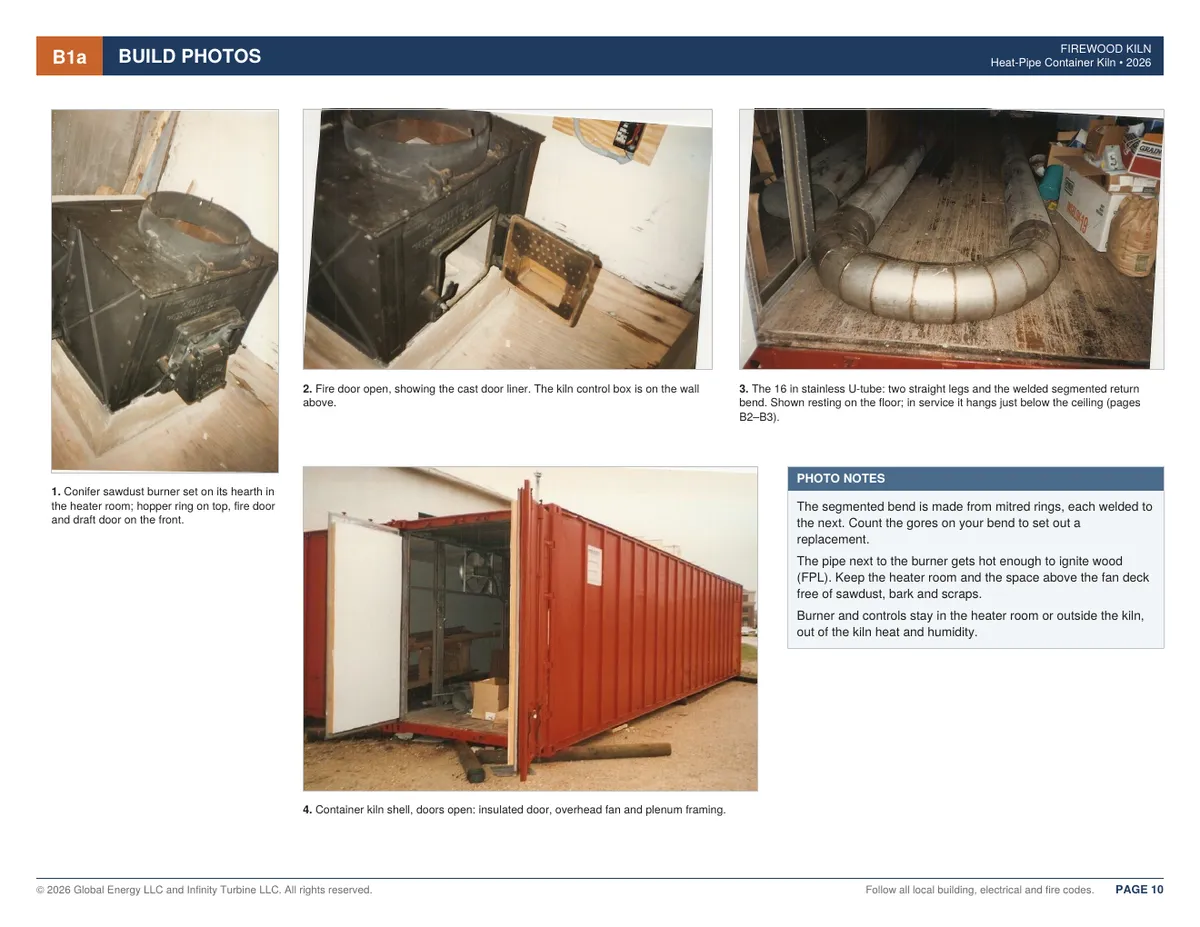
Wood-fired kilns have a long history of fires. The publication's heat-pipe details, operating and safety checklist and burner pages cover clearances, the burner interlock and safe start-up and shutdown. Read them before you build or fire the kiln, and check local building, electrical and fire codes, your insurer and firewood heat-treatment rules.
The Furnace-Type Kiln is written for lumber and reproduces the full 1945 FPL report. This edition is written for firewood: a firewood-drying guide, firewood bins and charges, a single-container option, and the container kiln's fans, VFD wiring and burner interlock.
A boiler, pump and coils cost money and need water treatment. A sawdust burner firing a heat pipe uses the mill's own residue as free fuel and gives clean, indirect heat. If you already have a boiler, the DIY or Solar container kiln plans fit better.
Green sawdust, chips and hogged fuel. Part E covers which fuels it can and cannot burn, with selection data and installation instructions.
The drawings use 4 × 4 × 5-1/2 ft bins. Surplus IBC tote cages are a low-cost alternative with built-in forklift slots.
Dry and heat-treat firewood in days, all year, with fuel you already have.