
Replacing the steel pressure vessel with a poured pad and a vacuum bag changes the capital picture — but the drying physics, and the electrical load, are governed by the same rules laid out in the U.S. Forest Products Laboratory's vacuum-drying research. Here is the power budget for a 5,000 board-foot charge.
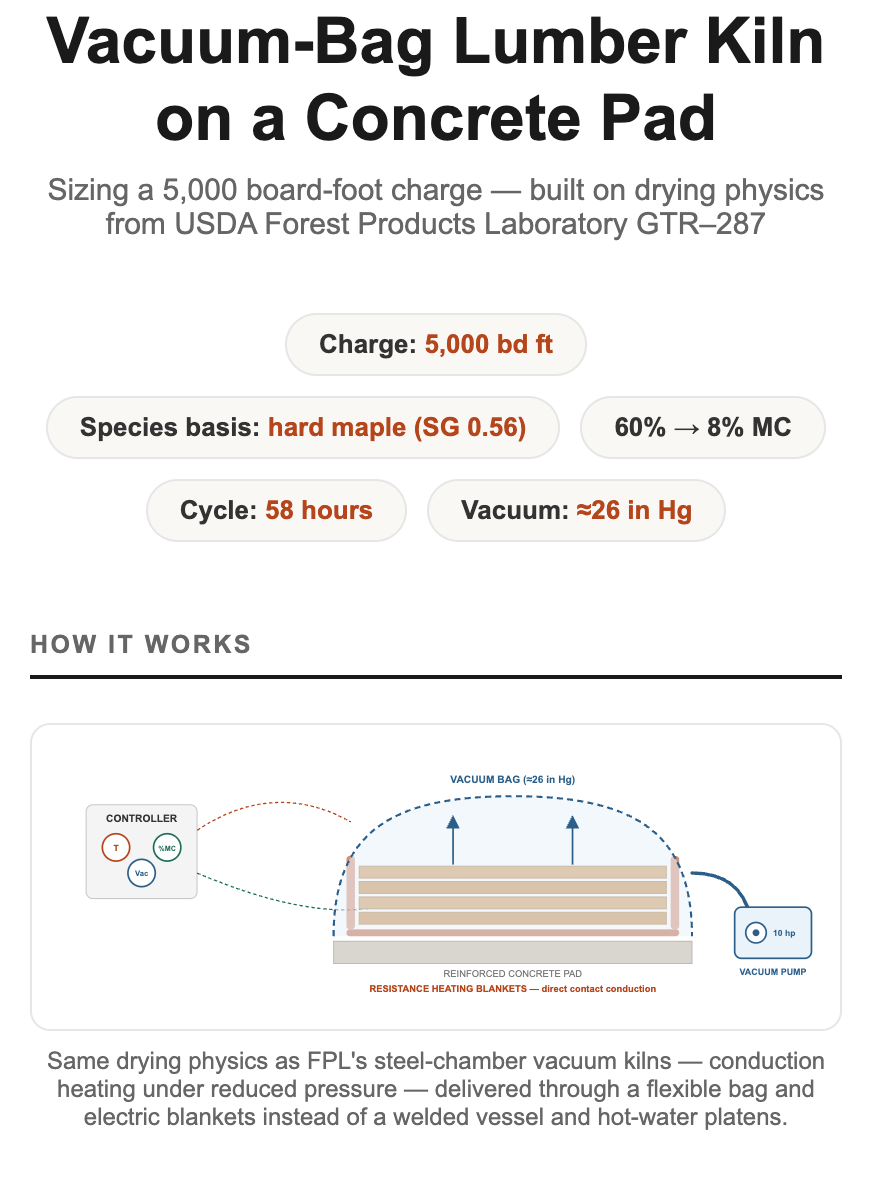
A vacuum kiln dries lumber faster than a conventional steam kiln because dropping the pressure inside the chamber lowers the boiling point of water, letting bound and free moisture leave the wood at temperatures as low as 100–140°F instead of the 180–200°F common in atmospheric kilns. The FPL report confirms the concept works and that it can be somewhat more energy efficient than steam drying — but the pressure vessel in every system it documents is a welded steel chamber. The concept examined here replaces that vessel with a reinforced concrete pad, a flexible vacuum bag draped over the lumber pack, and electric resistance heating blankets placed above, below, and around the stack. Two electrical loads carry the process: the vacuum pump and the resistance heaters, both managed by a controller that tracks core temperature, chamber vacuum, and moisture removal rate.
FPL identifies four ways heat can be delivered inside a vacuum kiln: direct-contact conduction (hot-water platens or electric blankets), convective heating/vacuum cycling, superheated steam, and radio-frequency/dielectric heating. The concrete-pad design falls into the first category — conduction by direct contact — the same mechanism FPL's featured commercial system uses, except hot water circulating through aluminum platens is replaced with electric resistance blankets in direct contact with the lumber pack. That substitution matters for the energy math: a resistance element converts electricity to heat at essentially 100% efficiency at the element itself, with no boiler or hot-water loop in between. What it does not solve is containment — a flexible bag sealed to a concrete pad is inherently leakier and less insulated than a welded, lagged steel shell, which is the main reason the loss allowance used below is generous.
The FPL report does not publish a standard vacuum-drying schedule by species and thickness — it says plainly that this is still missing from the industry. So the calculation below is built from first principles (mass of water to remove, latent heat, sensible heat) rather than scaled off a single reported number, and the assumptions are stated explicitly so they can be swapped for a different species or product line.
| Parameter | Value | Basis |
|---|---|---|
| Charge size | 5,000 board ft (11.8 m³ green) | User specification |
| Reference species | Hard maple equivalent, SG 0.56 | Matches FPL's featured case study |
| Green moisture content | 60% (oven-dry basis) | Typical hardwood green MC |
| Target final moisture content | 8% | Standard kiln-dry target |
| Oven-dry wood mass | 6,607 kg (14,566 lb) | SG × green volume |
| Vacuum level / core temperature | ≈26 in Hg / up to 140°F (60°C) | FPL-cited operating range |
| Cycle time | 58 hours | FPL benchmark for 1-in. hard maple; time is set by board thickness, not stack volume |
Two heat loads make up the process energy: latent heat to vaporize the water, and sensible heat to raise the wood and remaining water from ambient to the vacuum-reduced boiling/core temperature.
| Component | Formula basis | Energy |
|---|---|---|
| Evaporation (latent heat) | 3,436 kg × 2,370 kJ/kg (hfg at 50–60°C) | 2,262 kWh |
| Sensible heat — wood | 6,607 kg × 1.7 kJ/kg·K × 40 K rise | 125 kWh |
| Sensible heat — water | 2,246 kg avg × 4.19 kJ/kg·K × 40 K rise | 104 kWh |
| Theoretical minimum | — | 2,491 kWh |
| System loss allowance (+35%) | Pad thermal mass, bag/ambient losses, imperfect blanket-to-lumber contact | + 872 kWh |
| Practical heating energy | — | 3,363 kWh |
The 35% loss allowance is deliberately higher than a well-insulated steel chamber would need. It covers three things specific to this design: the concrete pad itself acts as a heat sink (an engaged pad mass of roughly 7,300 kg absorbs about 72 kWh warming up on every cycle), the vacuum bag has far less insulating value than a lagged steel shell, and direct-contact blankets rarely achieve perfect, even contact across an entire lumber pack the way rigid platens do.
| Quantity | Value |
|---|---|
| Average heater power (3,363 kWh ÷ 58 hr) | 58.0 kW |
| Installed / peak capacity (×1.75 for the front-loaded boil-off phase) | 101.5 kW |
Vacuum-drying schedules are front-loaded: the heaviest evaporative load hits once the core reaches boiling temperature for the chamber pressure and holds there while free water flashes off, then tapers as the wood approaches its target MC and drying shifts to diffusion-limited bound water. Sizing the blanket bank to roughly 1.75× the cycle average (about 100 kW installed, e.g., twenty 5 kW zones on a staged contactor bank) keeps the controller able to hold setpoint through that peak without oversizing the whole system for a load it only sees part of the time.
The pump has two duties: pulling the bag down to operating vacuum at the start of the cycle, and then continuously clearing water vapor to hold that vacuum while the blankets are driving evaporation.
| Quantity | Value |
|---|---|
| Estimated bag-enclosed air volume (5,000 bf stack + stickers + headspace) | ≈28 m³ (1,000 ft³) |
| Ideal work to pull down to 26 in Hg | 1.7 kWh |
| Pump power for a 20-min pulldown at 50% pump efficiency | ≈10 kW |
| Recommended pump motor | 10 hp (7.5 kW) |
| Running duty during hold phase (cycling, not continuous) | ≈35% |
| Pump energy over the 58-hour cycle | 151 kWh |
A flexible bag sealed to a concrete pad perimeter is inherently more leak-prone than a welded steel vessel, which is why the recommended motor (10 hp) sits above the 5–7.5 hp range typical of comparable steel-chamber vacuum kilns. Pad-edge sealing detail is the highest-leverage design item for keeping the pump at the smaller end of that range in practice.
| Item | Value |
|---|---|
| Heater (peak) + pump (nameplate) + controls | 101.5 + 7.5 + 1.0 = 110.0 kW |
| Current draw at 480 V, 3-phase, pf 0.96 | ≈138 A |
| NEC-style 125% continuous-load factor | ≈172 A |
| Recommended service / main breaker | 175–200 A, 480 V 3-phase |
| Total energy per 5,000 bf charge (heater + pump) | 3,515 kWh |
| Energy intensity | 703 kWh per 1,000 bf |
A 480 V three-phase service is assumed because a 110 kW resistive load at 240 V would draw over 275 A continuous — impractical for blanket wiring and contactor sizing. If only single-phase or 240 V service is available on site, the heater bank should be split into more, smaller zones and staged rather than run as one block.
The single largest lever in this whole budget is how much water has to leave the wood, which is set almost entirely by the starting moisture content. The table below runs the same method against three other realistic operating cases for a container-class kiln built to also handle poles, beams, firewood, and heat treating.
| Scenario | Water removed | Heating energy | Avg. heater power |
|---|---|---|---|
| Green (60%) → 8% MC — full kiln-dry design case | 3,436 kg | 3,363 kWh | 58.0 kW |
| Air-dried (30%) → 8% MC — pre-dried stock | 1,454 kg | 1,539 kWh | 26.5 kW |
| Green (60%) → 20% MC — firewood / rough stock | 2,643 kg | 2,683 kWh | 46.3 kW |
| Heat treatment only (ISPM-15: core to 160°F, 75-min soak) short cycle | — | 321 kWh | 98.6 kW over ~3.2 hr |
Air-drying stock to roughly 30% MC before it goes into the vacuum bag — standard industry practice for saving kiln energy — cuts the heating load by more than half. Heat treatment alone (bringing the core to 160°F and holding it, without driving off significant moisture) is a short, intense burst rather than a sustained load, and would let the same 100 kW-class heater bank turn a charge around in a few hours instead of two and a half days.
FPL reports that its featured vacuum kiln averaged 166 kWh/day of electrical use against 179 kWh/day for a paired conventional steam kiln (about 7% less per day), and that because the vacuum charge finished in 58 hours versus 288 hours, the total cost to dry that charge was roughly $44 versus $236 at $0.11/kWh — a savings driven mostly by time, not by a dramatically lower power draw. FPL does not publish the board footage of that specific charge, so it isn't used here to scale a per-board-foot energy figure; it's cited only as directional confirmation that vacuum drying is meaningfully faster and modestly more energy-efficient per day than conventional steam drying, which is consistent with the physics behind the concrete-pad design.
Reference USDA Article: Understanding Vacuum Drying Technologies for Commercial Lumber Use a wood-fire boiler and save 90 percent on electrical energy costs |
|
Use a wood-fire boiler and save 90 percent on electrical energy costs |
| CONTACT Email: greg@globalmicroturbine.com | AMP | PDF |