
PDF Publication Title:
Text from PDF Page: 112
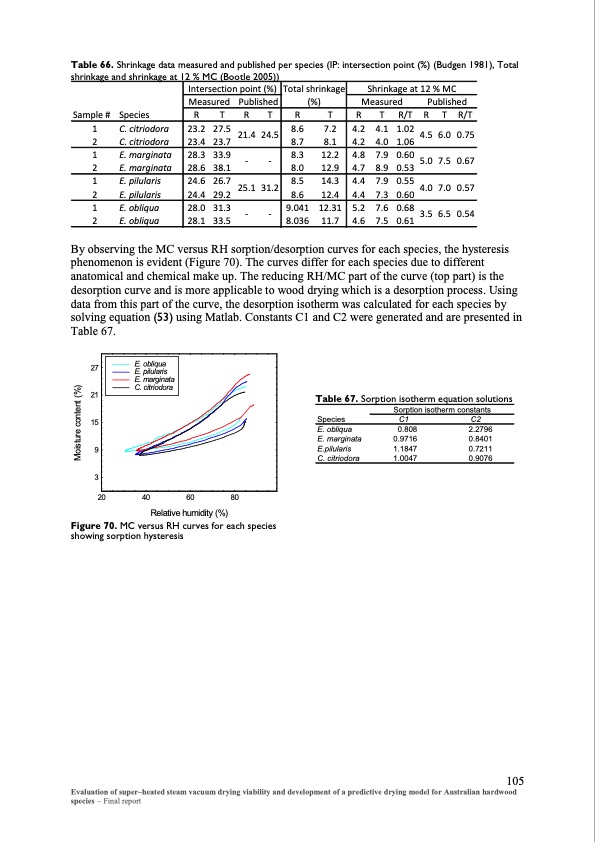
Table 66. Shrinkage data measured and published per species (IP: intersection point (%) (Budgen 1981), Total shrinkage and shrinkage at 12 % MC (Bootle 2005)) Shrinkage at Measured 12 % MC Published R T R/T 4.5 6.0 0.75 5.0 7.5 0.67 4.0 7.0 0.57 3.5 6.5 0.54 Intersection point (%) Total shrinkage (%) Measured Published RTRT RT 23.2 27.5 21.4 24.5 23.4 23.7 8.6 7.2 8.7 8.1 28.3 33.9 28.6 38.1 -- 8.3 12.2 8.0 12.9 24.6 26.7 25.1 31.2 24.4 29.2 8.5 14.3 8.6 12.4 28.0 31.3 28.1 33.5 -- 9.041 12.31 8.036 11.7 Sample # 1 2 1 2 1 2 1 2 Species C. citriodora C. citriodora E. marginata E. marginata E. pilularis E. pilularis E. obliqua E. obliqua R T 4.2 4.1 4.2 4.0 1.06 R/T 1.02 4.8 7.9 4.7 8.9 0.53 0.60 By observing the MC versus RH sorption/desorption curves for each species, the hysteresis phenomenon is evident (Figure 70). The curves differ for each species due to different anatomical and chemical make up. The reducing RH/MC part of the curve (top part) is the desorption curve and is more applicable to wood drying which is a desorption process. Using data from this part of the curve, the desorption isotherm was calculated for each species by solving equation (53) using Matlab. Constants C1 and C2 were generated and are presented in Table 67. 4.4 7.9 4.4 7.3 0.60 0.55 5.2 7.6 4.6 7.5 0.61 0.68 E. obliqua E. pilularis E. marginata C. citriodora 27 21 15 9 3 20 40 60 80 Relative humidity (%) Figure 70. MC versus RH curves for each species showing sorption hysteresis Table 67. Sorption isotherm equation solutions Species E. obliqua E. marginata E.pilularis C. citriodora Sorption isotherm constants C1 C2 0.808 2.2796 0.9716 0.8401 1.1847 0.7211 1.0047 0.9076 Evaluation of super–heated steam vacuum drying viability and development of a predictive drying model for Australian hardwood species – Final report 105 Moisture content (%)PDF Image | Evaluation of super-heated steam vacuum drying
PDF Search Title:
Evaluation of super-heated steam vacuum dryingOriginal File Name Searched:
PN08_2047_Vacuum_Drying_Reviewed_Report.pdfDIY PDF Search: Google It | Yahoo | Bing
5,000 BF Shipping Container Lumber Dry Kiln For Quality Lumber The 5,000 BF container kiln consists of one 40 foot high-cube aluminum shipping container... More Info
Shipping Container Lumber Dry Kilns by Global Energy Global Energy designed and developed the container kiln back in 1991. The purpose is to give access to portable sawmill owners, furniture makers, and small business the value added profit of dry kiln lumber and quality hardwoods... More Info
Vacuum Kiln Conversion Kit for Lumber and Wood Dry Kilns Convert your existing conventional dry kiln into a fast drying vacuum kiln. Similar to vacuum bagging in the boat building and aircraft industry, we have come up with a proprietary process which allows you to build a very simple vacuum kiln at a fraction of the price, and without the intensive conventional metal chamber structure... More Info
Vacuum Pump Cart System for Bagging Clamping Wood Drying and more Vacuum Cart with 2HP Pump and Dual Pistons with multiple multiplex vacuum ports and liquid reservoir... More Info
Vacuum Bagging Basics Vacuum bagging is a method of clamping, which has traditionally been used in the composites industry, but can also be used for vacuum drying materials, including wood products... More Info
| CONTACT TEL: 608-238-6001 Email: greg@globalmicroturbine.com | RSS | AMP |