
PDF Publication Title:
Text from PDF Page: 089
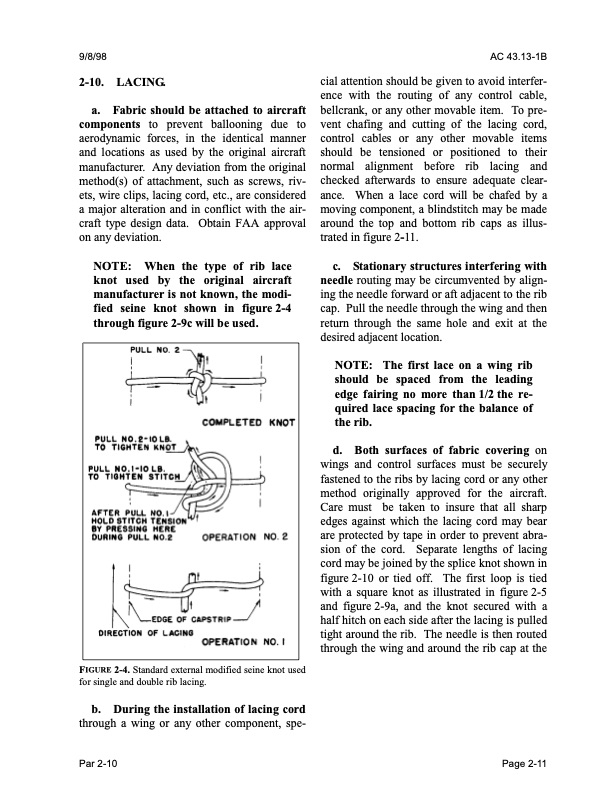
9/8/98 AC 43.13-1B 2-10. LACING. a. Fabric should be attached to aircraft components to prevent ballooning due to aerodynamic forces, in the identical manner and locations as used by the original aircraft manufacturer. Any deviation from the original method(s) of attachment, such as screws, riv ets, wire clips, lacing cord, etc., are considered a major alteration and in conflict with the air craft type design data. Obtain FAA approval on any deviation. NOTE: When the type of rib lace knot used by the original aircraft manufacturer is not known, the modi- fied seine knot shown in figure 2-4 through figure 2-9c will be used. FIGURE 2-4. Standard external modified seine knot used for single and double rib lacing. b. During the installation of lacing cord through a wing or any other component, spe cial attention should be given to avoid interfer ence with the routing of any control cable, bellcrank, or any other movable item. To pre vent chafing and cutting of the lacing cord, control cables or any other movable items should be tensioned or positioned to their normal alignment before rib lacing and checked afterwards to ensure adequate clear ance. When a lace cord will be chafed by a moving component, a blindstitch may be made around the top and bottom rib caps as illus trated in figure 2-11. c. Stationary structures interfering with needle routing may be circumvented by align ing the needle forward or aft adjacent to the rib cap. Pull the needle through the wing and then return through the same hole and exit at the desired adjacent location. NOTE: The first lace on a wing rib should be spaced from the leading edge fairing no more than 1/2 the re- quired lace spacing for the balance of the rib. d. Both surfaces of fabric covering on wings and control surfaces must be securely fastened to the ribs by lacing cord or any other method originally approved for the aircraft. Care must be taken to insure that all sharp edges against which the lacing cord may bear are protected by tape in order to prevent abra sion of the cord. Separate lengths of lacing cord may be joined by the splice knot shown in figure 2-10 or tied off. The first loop is tied with a square knot as illustrated in figure 2-5 and figure 2-9a, and the knot secured with a half hitch on each side after the lacing is pulled tight around the rib. The needle is then routed through the wing and around the rib cap at the Par 2-10 Page 2-11PDF Image | AFS-640
PDF Search Title:
AFS-640Original File Name Searched:
ac_43.13-1b_w-chg1.pdfDIY PDF Search: Google It | Yahoo | Bing
5,000 BF Shipping Container Lumber Dry Kiln For Quality Lumber The 5,000 BF container kiln consists of one 40 foot high-cube aluminum shipping container... More Info
Shipping Container Lumber Dry Kilns by Global Energy Global Energy designed and developed the container kiln back in 1991. The purpose is to give access to portable sawmill owners, furniture makers, and small business the value added profit of dry kiln lumber and quality hardwoods... More Info
Vacuum Kiln Conversion Kit for Lumber and Wood Dry Kilns Convert your existing conventional dry kiln into a fast drying vacuum kiln. Similar to vacuum bagging in the boat building and aircraft industry, we have come up with a proprietary process which allows you to build a very simple vacuum kiln at a fraction of the price, and without the intensive conventional metal chamber structure... More Info
Vacuum Pump Cart System for Bagging Clamping Wood Drying and more Vacuum Cart with 2HP Pump and Dual Pistons with multiple multiplex vacuum ports and liquid reservoir... More Info
Vacuum Bagging Basics Vacuum bagging is a method of clamping, which has traditionally been used in the composites industry, but can also be used for vacuum drying materials, including wood products... More Info
| CONTACT TEL: 608-238-6001 Email: greg@globalmicroturbine.com | RSS | AMP |