
Global Energy Sales | Plans | Consulting TEL: 1-608-238-6001 Email: greg@globalmicroturbine.com
5000 BF Kiln for Lumber and Firewood Plans, parts, or full build using natural gas, propane, or wood heat via heat pipe or hot water... More Info
15000 BF Kiln for Lumber and Firewood Plans, parts, or full build using natural gas, propane, or wood heat via heat pipe or hot water... More Info
ElectraTherm 125 kWe ORC and Hurst Boiler For Sale | Biomass and Waste Heat to Energy This pre-packaged 40-foot container combines a 125 kWe Organic Rankine Cycle generator with an industrial Hurst boiler to deliver grid-ready electricity from heat that would otherwise be wasted. With minimal runtime and turnkey integration, this mobile energy platform enables rapid deployment for biomass systems, industrial facilities, and distributed power projects where reliable on-site generation is required. More Info
|
Enhancing Lime-Based Cement with Exfoliated Graphene from Electrolysis of Limestone Teaser:A breakthrough electrolysis process can reduce limestone slurry into lime while exfoliating graphene from a graphite cathode. This dual output enhances cement strength and introduces a sustainable method for graphene production.---Dual Output Electrolysis: Producing Lime and Exfoliated GrapheneIn an innovative electrochemical process, limestone slurry is reduced to lime (CaO) at the anode, while a graphite cathode simultaneously undergoes exfoliation, producing graphene or graphitic flakes as a byproduct. This approach not only simplifies the production of lime for use in cement and concrete, but also yields exfoliated graphene, a material known for its exceptional mechanical strength and conductivity.---Graphite Cathode Exfoliation: Producing GrapheneWhen a graphite electrode is used as the cathode in the electrolysis of limestone slurry in saline water, gas evolution (hydrogen) and electrochemical reduction lead to the exfoliation of graphite into few-layer graphene (FLG), graphene oxide, or graphite nanoplatelets, depending on current density, electrolyte, and temperature.Estimated Yield:Assuming a practical electrolysis setup:Graphite consumption rate: \~10–20 grams per kWh of electrolysisElectrolysis energy: \~4 kWh per kg of lime producedFor every 1000 kg of lime, approximately:40–80 kWh electricity used400–800 grams of exfoliated graphene produced> Yield Estimate:> 0.4 to 0.8 kg of exfoliated graphene per metric ton of lime---Mechanical Enhancement of CementEven low concentrations of graphene (0.05–0.5% by weight) in cement can dramatically increase:Compressive strength: up to 40 percentTensile and flexural strength: 25–30 percentWater resistance and shrinkage controlAssuming 0.5 kg of exfoliated graphene per ton of lime:When used in cement formulation (lime plus aggregate and water), the graphene fraction can be tuned to 0.05–0.2 percent of cement massThis is within the optimal range for strength and performance gains based on academic studies> Result:> The lime produced via this method is self-reinforced with graphene, resulting in stronger, more durable concrete without external additives---Benefits and ApplicationsSimultaneous material production (lime and graphene)Eliminates the need for external carbon additivesSustainable cement manufacturingReduced carbon footprint compared to kiln-based lime productionHigh-performance construction materials with increased service life---ConclusionThis integrated electrolysis method represents a significant innovation for green construction. By using a graphite cathode, not only is lime produced from limestone slurry, but exfoliated graphene is also generated in useful quantities. The resulting graphene-reinforced lime slurry improves cement and concrete strength, water resistance, and structural durability—all while offering a scalable, energy-efficient alternative to traditional cement manufacturing. |
| Page Title:Energy and Graphite Consumption in Electrolytic Lime Production with Graphene ReinforcementMeta Description:Learn how much energy and graphite cathode material is consumed when processing 1 kg of limestone slurry into lime via electrolysis, including the amount of exfoliated graphene added to the slurry for enhanced cement properties.Teaser:In electrolytic lime production, graphite cathodes serve a dual purpose: enabling lime production and exfoliating into graphene. Discover the energy requirements and material balance for converting 1 kg of limestone slurry into a graphene-enhanced lime slurry.---Electrolysis of Limestone Slurry: Energy Use and Graphite Cathode ConsumptionAn advanced method of producing lime (CaO) from limestone slurry via electrolysis offers an environmentally friendly alternative to traditional rotary kiln calcination. A key feature of this process is that it uses a graphite cathode, which not only enables the electrochemical reaction but also serves as a sacrificial material, gradually exfoliating into graphene or graphite nanoplatelets. These exfoliated particles become embedded in the lime slurry, improving mechanical strength in subsequent cement and concrete applications.---1. Energy Required to Process 1 kg of LimestoneThe electrolysis of limestone slurry requires:Energy input: \~4.0 to 4.5 kWh per kg of lime (CaO) producedIncludes both anode oxidation and cathode hydrogen generation> Metric: 4.0–4.5 kWh/kg of lime> Imperial: 13,650–15,340 BTU/lb of lime---2. Graphite Cathode Consumption per kg of LimeGraphite electrodes slowly erode during electrolysis, primarily due to hydrogen evolution and mechanical exfoliation. Based on experimental data and graphite electrochemical erosion rates:Consumption estimate: \~10 to 20 grams of graphite per kWhThus, for 1 kg of lime (at 4.0 to 4.5 kWh energy input):> Graphite consumption:>> Metric: 40 to 90 grams per kg of lime> Imperial: 0.088 to 0.198 pounds per 2.2 lbs of lime---3. Exfoliated Graphene Imported into Lime SlurryNot all graphite is exfoliated into usable graphene, but a portion (typically 30–50 percent) is converted into few-layer graphene or nanoplatelets, which remain suspended in the slurry:Exfoliated graphene yield:\~15 to 45 grams per kg of lime(or 0.033 to 0.099 pounds per 2.2 lbs of lime)This quantity is well within the optimal reinforcement range (0.05–0.3 percent by weight in cementitious materials) for increasing compressive and flexural strength.---Summary Table: Electrolysis of 1 kg of Limestone Slurry| Parameter | Metric Value | Imperial Value || ------------------------------• | -----------• | -------------------• || Energy Input | 4.0–4.5 kWh | 13,650–15,340 BTU/lb || Graphite Cathode Consumed | 40–90 grams | 0.088–0.198 lbs || Exfoliated Graphene into Slurry | 15–45 grams | 0.033–0.099 lbs |---Application BenefitsSimultaneous production of lime and grapheneImproved cement strength with in-situ reinforcementLower carbon emissions than kiln-based limeNo external additives required for concrete enhancement---ConclusionUsing graphite as a sacrificial cathode in the electrolysis of limestone slurry not only facilitates lime production but also introduces exfoliated graphene directly into the resulting lime. For every kilogram of lime produced, up to 45 grams of graphene may be embedded in the slurry, enhancing the final mechanical properties of cement and concrete. This dual-function approach improves efficiency, reduces emissions, and delivers next-generation construction materials using a low-energy, scalable process. |
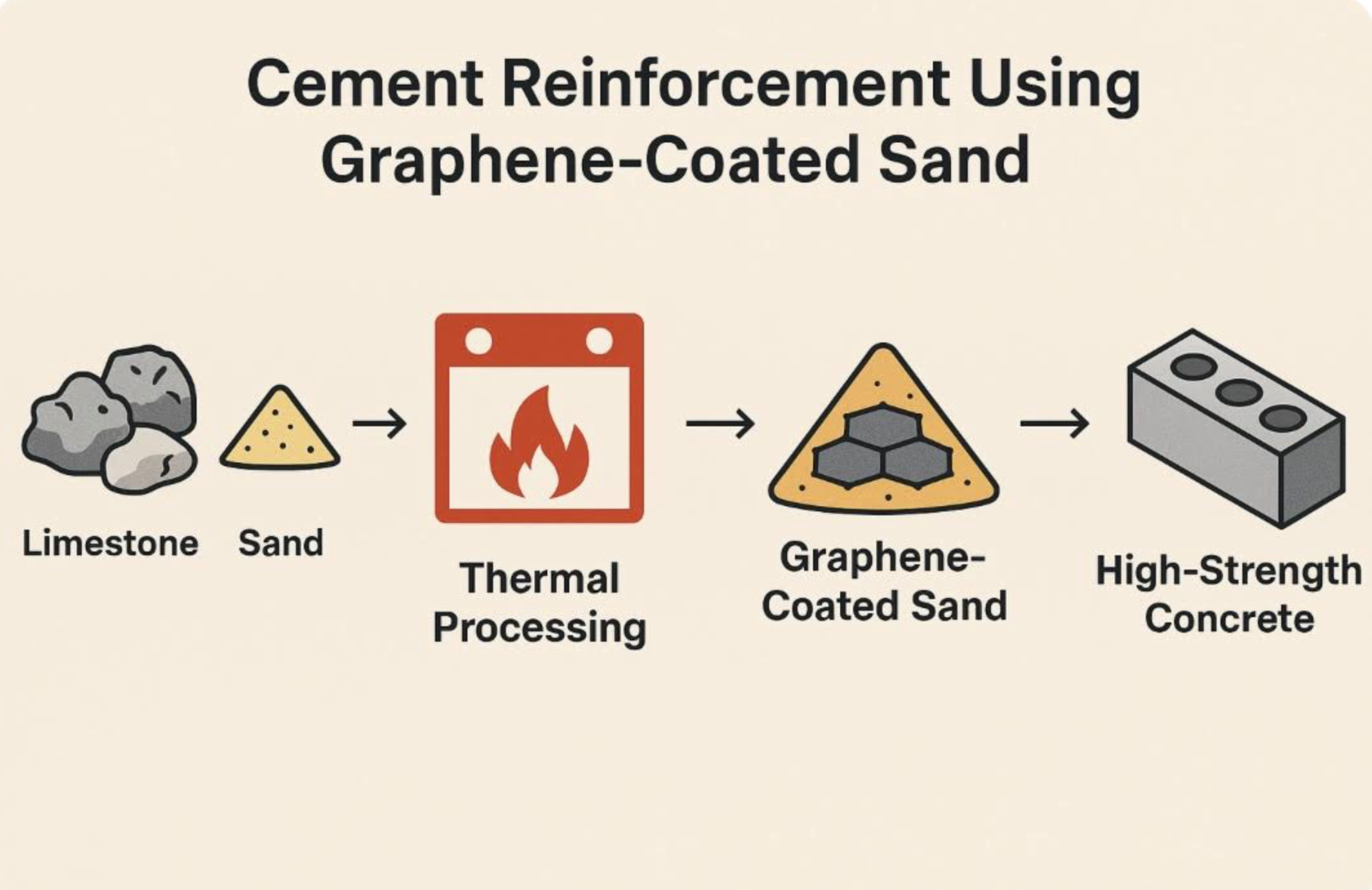
| Page Title:Cement Reinforcement Using Graphene-Coated Sand from Sugar-Assisted Lime ReductionMeta Description:Explore a novel cement production method that combines lime, sand, and sugar in high-temperature processing to create graphene-coated sand. This approach improves concrete strength through in-situ graphene formation during lime production.Teaser:A new technique in cement production layers lime, sand, and sugar to produce graphene-coated sand during the lime reduction process. This enhances the strength and durability of concrete without requiring external additives.---Graphene-Coated Sand for High-Strength Concrete: A New Approach in Lime-Based Cement ProductionA groundbreaking method in cement production combines traditional lime reduction with a materials science enhancement: the creation of graphene-coated sand within the cement matrix. This method involves layering limestone, sand, and sugar, then heating the mixture to the required calcination temperature. The result is not just lime, but also exfoliated graphene that bonds to sand particles, producing a superior composite for high-performance concrete.---Process Overview1. Material Preparation:Crushed limestone is mixed with fine silica sandSugar, typically sucrose, is uniformly layered or sprayed into the mix2. Thermal Processing:The mix is heated to \~900 to 950°C (1,650 to 1,740°F)At this temperature, CaCO₃ decomposes into CaO and CO₂The sugar undergoes thermal decomposition, releasing carbon radicals and gasesIn the presence of silica sand, this carbon exfoliates into graphitic structures and coats the sand surface3. Formation of Graphene-Coated Sand:Carbon vapors from sugar bond to silica via pyrolytic depositionResulting sand grains are coated with few-layer graphene or graphitic carbonThese graphene-enhanced aggregates are blended with the lime to form cement---Functional Roles of Each MaterialLimestone (CaCO₃): Primary source of lime for cement chemistrySand (SiO₂): Structural filler and base for graphene coatingSugar (C₁₂H₂₂O₁₁): Carbon source that decomposes into volatile carbon species, enabling in-situ exfoliation and graphene deposition---Benefits of Graphene-Coated SandImproved Compressive Strength: Graphene increases particle bonding and load transfer within the concrete matrixEnhanced Flexural and Tensile Strength: Few-layer graphene creates a network that mitigates microcrackingReduced Water Permeability: Graphene reduces pore formation and improves barrier propertiesNo Need for External Nanomaterials: Reinforcement occurs within the batch, simplifying logistics---End Result: High-Performance CementThe cement produced from this process contains:Lime (CaO) from decomposed limestoneGraphene-coated silica sand as functional aggregateIn-situ reinforcement without the need for mechanical exfoliation or external graphene supplyThis results in concrete that is:StrongerMore durableLess prone to shrinkage and cracking---Environmental and Process AdvantagesEliminates the need for carbon-intensive rotary kilns aloneUtilizes common materials like sugar as a clean carbon sourceAvoids the industrial handling of powdered graphene or carbon nanotubesScalable with conventional batch or rotary thermal processing systems---ConclusionThis hybrid method of combining sugar, sand, and limestone in cement production introduces a powerful material advantage: graphene-coated sand, formed in-situ during thermal processing. By enhancing the structural properties of concrete with embedded carbon nanomaterials, this method points to a more efficient, scalable, and durable future for construction materials without relying on expensive additives or complex manufacturing chains. |
|
Graphene-Enhanced Cement: Advancing Strength and Durability in Concrete Page Title:Graphene-Enhanced Cement: Advancing Strength and Durability in ConcreteMeta Description:Discover how graphene-enhanced cement improves compressive, flexural, and tensile strength in concrete by up to 40 percent. Explore its performance benefits, applications, and integration into next-generation construction materials.Teaser:Graphene-infused cement represents a leap forward in construction materials, delivering up to 40 percent higher compressive strength and superior crack resistance. Learn how this innovation is reshaping the future of concrete durability and performance.---Graphene-Enhanced Cement: The Future of Stronger, Smarter ConcreteThe global construction industry is in constant pursuit of materials that are stronger, more durable, and environmentally sustainable. One of the most promising advancements is graphene-enhanced cement, which incorporates graphene nanoplatelets or exfoliated graphene directly into the cement or aggregate mix. The result is a high-performance composite material that significantly outperforms traditional concrete.---What Is Graphene-Enhanced Cement?Graphene-enhanced cement is a composite material made by adding a small fraction of graphene—a two-dimensional sheet of carbon atoms—into the cementitious matrix. This can be done by:Directly mixing graphene nanoplatelets into wet cementUsing graphene-coated sand produced via thermal or electrochemical exfoliationEmbedding graphene oxide into the water mix or admixture phaseEven in small amounts (typically 0.05 to 0.5 percent by weight), graphene creates a micro-reinforcing network that dramatically improves the mechanical and durability properties of concrete.---Performance Benefits1. Compressive StrengthStandard concrete compressive strength: \~4,000 psi (27.6 MPa)Graphene-enhanced concrete:20 percent gain = 4,800 psi (33.1 MPa)40 percent gain = 5,600 psi (38.6 MPa)2. Flexural and Tensile StrengthImprovements up to 25–30 percent observedReduced microcracking and better crack bridgingLonger lifespan under cyclic loading and dynamic stress3. Water Permeability and ShrinkageGraphene acts as a barrier to moistureDecreases water ingress and drying shrinkageReduces long-term degradation and corrosion in rebar structures4. Thermal ConductivityEnhanced heat dissipation and thermal resistanceUseful in high-load infrastructure and industrial floors---Supporting Data| Property | Standard Concrete | Graphene-Enhanced (20%) | Graphene-Enhanced (40%) || ---------------------------• | ----------------• | ----------------------• | ----------------------• || Compressive Strength (psi) | 4,000 | 4,800 | 5,600 || Compressive Strength (MPa) | 27.6 | 33.1 | 38.6 || Flexural Strength Increase | Baseline | +25 percent | +30 percent || Water Permeability Reduction | Baseline | -30 percent | -50 percent || Crack Resistance | Normal | Improved | Significantly Improved |---ApplicationsInfrastructure: Bridges, tunnels, highway surfacesBuildings: Foundations, structural walls, columnsMarine: Coastal defenses, ports, offshore structuresPrecast Products: Paving stones, panels, blocksIndustrial: High-wear floors, heat-exposed surfaces---Environmental AdvantagesLower cement usage: Improved strength allows for thinner sectionsExtended lifespan: Less frequent repairs and replacementsCarbon footprint offset: Can be integrated into electrolysis-based lime production processes that eliminate kiln CO₂ emissions---ConclusionGraphene-enhanced cement is a transformative material for the construction industry. By incorporating a small quantity of graphene into conventional cement systems, builders can achieve up to 40 percent greater strength, better durability, and lower long-term maintenance. As costs decrease and scalable production methods advance, graphene-infused concrete is set to become a mainstream material in infrastructure and green construction.
|
| CONTACT TEL: 608-238-6001 Email: greg@globalmicroturbine.com | AMP | PDF |