
PDF Publication Title:
Text from PDF Page: 517
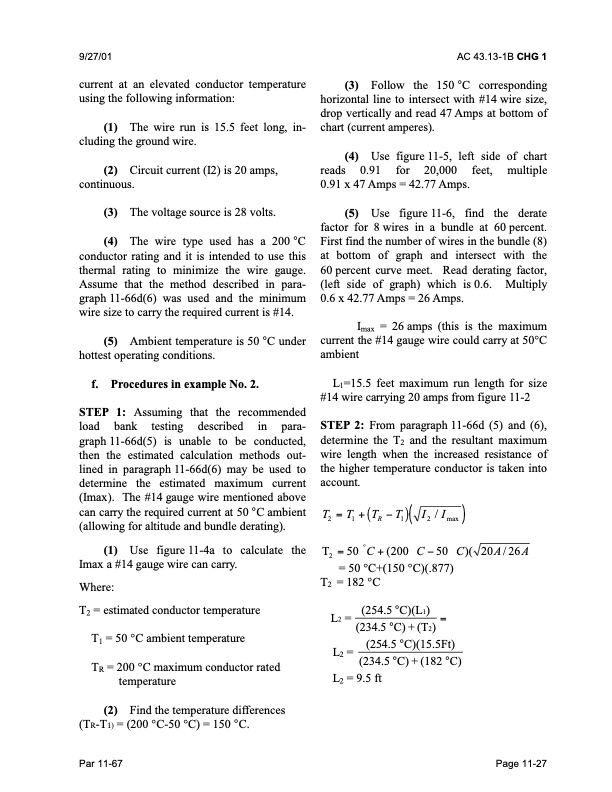
9/27/01 AC 43.13-1B CHG 1 current at an elevated conductor temperature using the following information: (1) The wire run is 15.5 feet long, in cluding the ground wire. (2) Circuit current (I2) is 20 amps, continuous. (3) The voltage source is 28 volts. (4) The wire type used has a 200 °C conductor rating and it is intended to use this thermal rating to minimize the wire gauge. Assume that the method described in para graph 11-66d(6) was used and the minimum wire size to carry the required current is #14. (5) Ambient temperature is 50 °C under hottest operating conditions. f. Procedures in example No. 2. STEP 1: Assuming that the recommended load bank testing described in para graph 11-66d(5) is unable to be conducted, then the estimated calculation methods out lined in paragraph 11-66d(6) may be used to determine the estimated maximum current (Imax). The #14 gauge wire mentioned above can carry the required current at 50 °C ambient (allowing for altitude and bundle derating). (1) Use figure 11-4a to calculate the Imax a #14 gauge wire can carry. Where: T2 = estimated conductor temperature T1 = 50 °C ambient temperature TR = 200 °C maximum conductor rated temperature (2) Find the temperature differences (TR-T1) = (200 °C-50 °C) = 150 °C. (3) Follow the 150 °C corresponding horizontal line to intersect with #14 wire size, drop vertically and read 47 Amps at bottom of chart (current amperes). (4) Use figure 11-5, left side of chart reads 0.91 for 20,000 feet, multiple 0.91 x 47 Amps = 42.77 Amps. (5) Use figure 11-6, find the derate factor for 8 wires in a bundle at 60 percent. First find the number of wires in the bundle (8) at bottom of graph and intersect with the 60 percent curve meet. Read derating factor, (left side of graph) which is 0.6. Multiply 0.6 x 42.77 Amps = 26 Amps. Imax = 26 amps (this is the maximum current the #14 gauge wire could carry at 50°C ambient L1=15.5 feet maximum run length for size #14 wire carrying 20 amps from figure 11-2 STEP 2: From paragraph 11-66d (5) and (6), determine the T2 and the resultant maximum wire length when the increased resistance of the higher temperature conductor is taken into account. T2 =T1 +(TR −T1)( I2 /Imax ) T2 =50°C+(200 C−50 C)( 20A/26A = 50 °C+(150 °C)(.877) T2 = 182 °C L2 = (254.5 °C)(L1) = (234.5 °C) + (T2) (254.5 °C)(15.5Ft) (234.5 °C) + (182 °C) L2 = L2 = 9.5 ft Par 11-67 Page 11-27PDF Image | AFS-640
PDF Search Title:
AFS-640Original File Name Searched:
ac_43.13-1b_w-chg1.pdfDIY PDF Search: Google It | Yahoo | Bing
5,000 BF Shipping Container Lumber Dry Kiln For Quality Lumber The 5,000 BF container kiln consists of one 40 foot high-cube aluminum shipping container... More Info
Shipping Container Lumber Dry Kilns by Global Energy Global Energy designed and developed the container kiln back in 1991. The purpose is to give access to portable sawmill owners, furniture makers, and small business the value added profit of dry kiln lumber and quality hardwoods... More Info
Vacuum Kiln Conversion Kit for Lumber and Wood Dry Kilns Convert your existing conventional dry kiln into a fast drying vacuum kiln. Similar to vacuum bagging in the boat building and aircraft industry, we have come up with a proprietary process which allows you to build a very simple vacuum kiln at a fraction of the price, and without the intensive conventional metal chamber structure... More Info
Vacuum Pump Cart System for Bagging Clamping Wood Drying and more Vacuum Cart with 2HP Pump and Dual Pistons with multiple multiplex vacuum ports and liquid reservoir... More Info
Vacuum Bagging Basics Vacuum bagging is a method of clamping, which has traditionally been used in the composites industry, but can also be used for vacuum drying materials, including wood products... More Info
| CONTACT TEL: 608-238-6001 Email: greg@globalmicroturbine.com | RSS | AMP |