
PDF Publication Title:
Text from PDF Page: 495
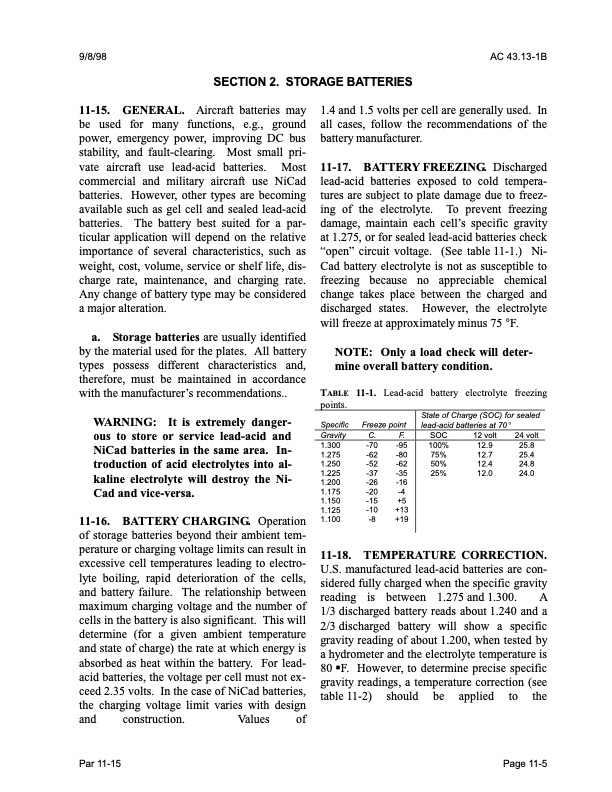
9/8/98 AC 43.13-1B 11-15. GENERAL. Aircraft batteries may be used for many functions, e.g., ground power, emergency power, improving DC bus stability, and fault-clearing. Most small pri- vate aircraft use lead-acid batteries. Most commercial and military aircraft use NiCad batteries. However, other types are becoming available such as gel cell and sealed lead-acid batteries. The battery best suited for a par- ticular application will depend on the relative importance of several characteristics, such as weight, cost, volume, service or shelf life, dis- charge rate, maintenance, and charging rate. Any change of battery type may be considered a major alteration. a. Storage batteries are usually identified by the material used for the plates. All battery types possess different characteristics and, therefore, must be maintained in accordance with the manufacturer’s recommendations.. WARNING: It is extremely danger- ous to store or service lead-acid and NiCad batteries in the same area. In- troduction of acid electrolytes into al- kaline electrolyte will destroy the Ni- Cad and vice-versa. 1.4 and 1.5 volts per cell are generally used. In all cases, follow the recommendations of the battery manufacturer. 11-17. BATTERYFREEZING. Discharged lead-acid batteries exposed to cold tempera- tures are subject to plate damage due to freez- ing of the electrolyte. To prevent freezing damage, maintain each cell’s specific gravity at 1.275, or for sealed lead-acid batteries check “open” circuit voltage. (See table 11-1.) Ni- Cad battery electrolyte is not as susceptible to freezing because no appreciable chemical change takes place between the charged and discharged states. However, the electrolyte will freeze at approximately minus 75 °F. NOTE: Only a load check will deter- mine overall battery condition. TABLE 11-1. Lead-acid battery electrolyte freezing points. SECTION 2. STORAGE BATTERIES State of Charge (SOC) for sealed 24 volt 25.8 25.4 24.8 24.0 11-18. TEMPERATURE CORRECTION. U.S. manufactured lead-acid batteries are con- sidered fully charged when the specific gravity reading is between 1.275 and 1.300. A 1/3 discharged battery reads about 1.240 and a 2/3 discharged battery will show a specific gravity reading of about 1.200, when tested by a hydrometer and the electrolyte temperature is 80 �F. However, to determine precise specific gravity readings, a temperature correction (see Specific Freeze point Gravity C. lead-acid batteries at 70° F. SOC 12 volt Operation of storage batteries beyond their ambient tem- perature or charging voltage limits can result in excessive cell temperatures leading to electro- lyte boiling, rapid deterioration of the cells, and battery failure. The relationship between maximum charging voltage and the number of cells in the battery is also significant. This will determine (for a given ambient temperature and state of charge) the rate at which energy is absorbed as heat within the battery. For lead- acid batteries, the voltage per cell must not ex- ceed 2.35 volts. In the case of NiCad batteries, the charging voltage limit varies with design and construction. Values of 1.300 -70 1.275 -62 1.250 -52 1.225 -37 1.200 -26 -16 1.175 -20 -4 1.150 -15 +5 1.125 -10 +13 1.100 -8 +19 11-16. BATTERY CHARGING. Par 11-15 Page 11-5 table 11-2) should be applied to the -95 100% 12.9 -80 75% 12.7 -62 50% 12.4 -35 25% 12.0PDF Image | AFS-640
PDF Search Title:
AFS-640Original File Name Searched:
ac_43.13-1b_w-chg1.pdfDIY PDF Search: Google It | Yahoo | Bing
5,000 BF Shipping Container Lumber Dry Kiln For Quality Lumber The 5,000 BF container kiln consists of one 40 foot high-cube aluminum shipping container... More Info
Shipping Container Lumber Dry Kilns by Global Energy Global Energy designed and developed the container kiln back in 1991. The purpose is to give access to portable sawmill owners, furniture makers, and small business the value added profit of dry kiln lumber and quality hardwoods... More Info
Vacuum Kiln Conversion Kit for Lumber and Wood Dry Kilns Convert your existing conventional dry kiln into a fast drying vacuum kiln. Similar to vacuum bagging in the boat building and aircraft industry, we have come up with a proprietary process which allows you to build a very simple vacuum kiln at a fraction of the price, and without the intensive conventional metal chamber structure... More Info
Vacuum Pump Cart System for Bagging Clamping Wood Drying and more Vacuum Cart with 2HP Pump and Dual Pistons with multiple multiplex vacuum ports and liquid reservoir... More Info
Vacuum Bagging Basics Vacuum bagging is a method of clamping, which has traditionally been used in the composites industry, but can also be used for vacuum drying materials, including wood products... More Info
| CONTACT TEL: 608-238-6001 Email: greg@globalmicroturbine.com | RSS | AMP |