
PDF Publication Title:
Text from PDF Page: 395
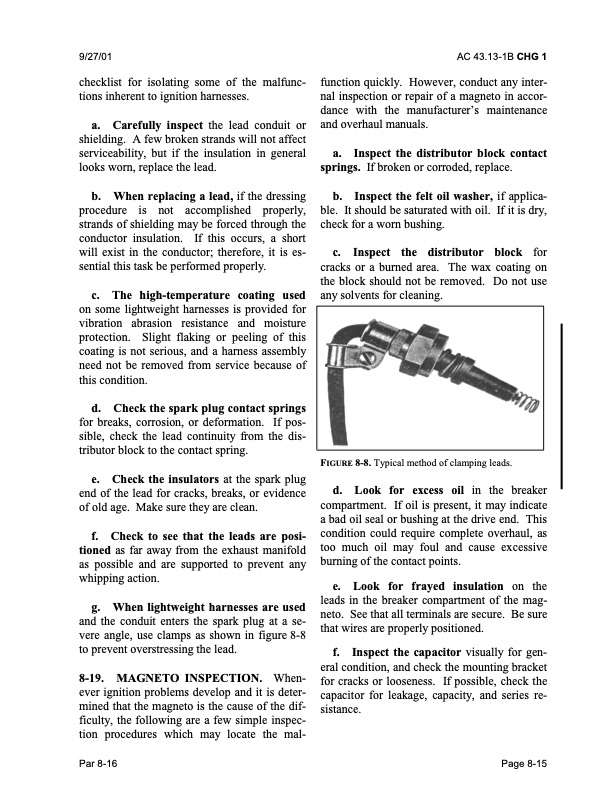
9/27/01 AC 43.13-1B CHG 1 checklist for isolating some of the malfunc- tions inherent to ignition harnesses. a. Carefully inspect the lead conduit or shielding. A few broken strands will not affect serviceability, but if the insulation in general looks worn, replace the lead. b. When replacing a lead, if the dressing procedure is not accomplished properly, strands of shielding may be forced through the conductor insulation. If this occurs, a short will exist in the conductor; therefore, it is es- sential this task be performed properly. c. The high-temperature coating used on some lightweight harnesses is provided for vibration abrasion resistance and moisture protection. Slight flaking or peeling of this coating is not serious, and a harness assembly need not be removed from service because of this condition. d. Check the spark plug contact springs for breaks, corrosion, or deformation. If pos- sible, check the lead continuity from the dis- tributor block to the contact spring. e. Check the insulators at the spark plug end of the lead for cracks, breaks, or evidence of old age. Make sure they are clean. f. Check to see that the leads are posi- tioned as far away from the exhaust manifold as possible and are supported to prevent any whipping action. g. When lightweight harnesses are used and the conduit enters the spark plug at a se- vere angle, use clamps as shown in figure 8-8 to prevent overstressing the lead. 8-19. MAGNETO INSPECTION. When- ever ignition problems develop and it is deter- mined that the magneto is the cause of the dif- ficulty, the following are a few simple inspec- tion procedures which may locate the mal- function quickly. However, conduct any inter- nal inspection or repair of a magneto in accor- dance with the manufacturer’s maintenance and overhaul manuals. a. Inspect the distributor block contact springs. If broken or corroded, replace. b. Inspect the felt oil washer, if applica- ble. It should be saturated with oil. If it is dry, check for a worn bushing. c. Inspect the distributor block for cracks or a burned area. The wax coating on the block should not be removed. Do not use any solvents for cleaning. FIGURE 8-8. Typical method of clamping leads. d. Look for excess oil in the breaker compartment. If oil is present, it may indicate a bad oil seal or bushing at the drive end. This condition could require complete overhaul, as too much oil may foul and cause excessive burning of the contact points. e. Look for frayed insulation on the leads in the breaker compartment of the mag- neto. See that all terminals are secure. Be sure that wires are properly positioned. f. Inspect the capacitor visually for gen- eral condition, and check the mounting bracket for cracks or looseness. If possible, check the capacitor for leakage, capacity, and series re- sistance. Par 8-16 Page 8-15PDF Image | AFS-640
PDF Search Title:
AFS-640Original File Name Searched:
ac_43.13-1b_w-chg1.pdfDIY PDF Search: Google It | Yahoo | Bing
5,000 BF Shipping Container Lumber Dry Kiln For Quality Lumber The 5,000 BF container kiln consists of one 40 foot high-cube aluminum shipping container... More Info
Shipping Container Lumber Dry Kilns by Global Energy Global Energy designed and developed the container kiln back in 1991. The purpose is to give access to portable sawmill owners, furniture makers, and small business the value added profit of dry kiln lumber and quality hardwoods... More Info
Vacuum Kiln Conversion Kit for Lumber and Wood Dry Kilns Convert your existing conventional dry kiln into a fast drying vacuum kiln. Similar to vacuum bagging in the boat building and aircraft industry, we have come up with a proprietary process which allows you to build a very simple vacuum kiln at a fraction of the price, and without the intensive conventional metal chamber structure... More Info
Vacuum Pump Cart System for Bagging Clamping Wood Drying and more Vacuum Cart with 2HP Pump and Dual Pistons with multiple multiplex vacuum ports and liquid reservoir... More Info
Vacuum Bagging Basics Vacuum bagging is a method of clamping, which has traditionally been used in the composites industry, but can also be used for vacuum drying materials, including wood products... More Info
| CONTACT TEL: 608-238-6001 Email: greg@globalmicroturbine.com | RSS | AMP |